Mediation gives you control over your divorce outcome without the cost, stress, and public exposure of court litigation—helping Orange County families move forward with dignity and fairness.
Share:


You’re facing one of the hardest decisions of your life, and the last thing you need is a process that drains your bank account, drags on for years, and plays out in public court records for anyone to see. If you and your spouse can still have a conversation—even a difficult, emotionally charged one—there’s a better path forward than traditional litigation. Mediation offers Orange County couples real control over their divorce outcome, transparent flat-fee costs, and a confidential environment where you make the final decisions, not a judge who barely knows your name and has 1,500 other cases on their docket. It’s not the easy road, but for many families navigating separation, it’s the right one. Here’s what you actually need to know about mediation, how it compares to courtroom battles, and whether it might work for your unique situation.
Mediation is a structured, legally recognized process where a neutral third party—the divorce mediation professional—helps you and your spouse negotiate the terms of your divorce outside of court. The mediator doesn’t make decisions for you, doesn’t take sides, and doesn’t act as a judge. They facilitate productive conversations, help you identify what matters most to your family’s future, and guide you toward workable agreements on everything from asset division to custody arrangements.
In Orange County, where approximately 33 people file for divorce every single day and the county has one of the highest divorce rates in California, mediation has become a practical, accessible alternative to the traditional courtroom route. It’s not couples therapy, and it’s not an informal chat over coffee. It’s a serious legal process with real structure, clear deadlines, and real consequences if you can’t ultimately reach an agreement.
The divorce mediation mediator’s job is to keep discussions moving forward, ensure both voices are genuinely heard and respected, and help you avoid the common emotional traps and tactical mistakes that derail negotiations and send couples straight to costly litigation. You still walk away with a legally binding divorce judgment that’s enforceable by the court. The fundamental difference is how you get there—and who controls the outcome.
Divorce mediation typically unfolds over several structured sessions, each lasting one to two hours depending on the complexity of your situation and how well you’re able to work together. You’ll start by meeting with your mediator to outline all the issues you need to resolve—parenting time schedules, child support calculations, spousal support amounts and duration, property division, debt allocation, and any other family-specific concerns. The mediator will explain California’s family law framework in plain language so you understand what a judge would likely decide if your case went to court. This isn’t about scaring you into quick agreement; it’s about giving you a realistic legal baseline and helping you make informed decisions.
Both spouses must participate in complete good faith, which means full, honest financial disclosure from day one. You’ll exchange bank statements, recent tax returns, complete asset lists, retirement account statements, credit card balances, and comprehensive debt information. Hiding assets, underreporting income, or lying about financial obligations doesn’t just torpedo the mediation process—it can blow up your entire divorce case and land you in serious legal trouble down the road, including potential perjury charges. The mediator will help you organize all this information systematically, identify any gaps or inconsistencies, and ensure both parties have access to the same financial picture.
As you methodically work through each issue on your agenda, the mediator helps you explore multiple options and creative solutions. Maybe you can’t immediately agree on who keeps the family house, but you can agree on how to fairly split retirement accounts and investment portfolios. Maybe custody feels completely impossible right now, but you can start with a temporary parenting schedule and build in a review process to revisit arrangements in six months once emotions settle. The goal isn’t achieving perfection on every single point; it’s making meaningful progress toward a workable settlement.
Mediation works best when you’re willing to honestly prioritize what truly matters to your family’s future and let go of what doesn’t serve anyone’s long-term interests. If you reach solid agreements on all major issues, the mediator will draft a comprehensive marital settlement agreement that covers every detail. You’ll review it carefully, request any necessary changes or clarifications, and sign when you’re satisfied. That agreement becomes an integral part of your final divorce judgment once a family court judge reviews and approves it.
If mediation stalls on certain specific issues but you’ve made progress on others, you can still take those particular disputes to court while preserving and enforcing the agreements you did successfully reach. It’s not an all-or-nothing proposition—partial agreements still save you time, money, and emotional energy.
Yes, you absolutely can get a divorce in California without hiring a traditional attorney to represent you in court. It’s called representing yourself “pro per” or “pro se,” and thousands of people across the state do it successfully every year. But whether you should attempt it is an entirely different question that depends heavily on your specific circumstances.
California law allows uncontested divorces where both spouses agree on all substantive terms without court intervention. You’ll still need to correctly file all required forms with the Orange County Superior Court, properly serve your spouse according to legal requirements, meet California’s residency requirements (six months in the state, three months in the county), and wait out the mandatory six-month cooling-off period that applies to every divorce. The court staff won’t give you legal advice about your specific situation, and if you mess up the paperwork or miss critical deadlines, you’ll face frustrating delays, outright rejections, or worse—agreements that don’t actually protect your interests.
For couples with minimal shared assets, no children, no real estate, and marriages lasting less than a few years, DIY divorce can genuinely work well. For everyone else dealing with real complexity, it’s genuinely risky and potentially costly in ways that aren’t immediately obvious.
Here’s what most people significantly underestimate when they consider going it alone: California is a community property state, which means all assets and debts acquired during the marriage get split 50/50 by default. That sounds straightforward and simple until you’re actually trying to properly divide a house with significant equity, a 401(k) or pension plan, a small business, stock options, or even just accurately figure out what legally counts as community property versus separate property you brought into the marriage. Mistakes in property division are often permanent and irreversible. Once the judge signs your final judgment, fixing errors is incredibly difficult, prohibitively expensive, and sometimes legally impossible.
If your spouse has hired a lawyer and you haven’t, you’re negotiating directly with a trained legal professional whose only job and ethical duty is to get the absolute best outcome for their client—not to be fair to you. You’re at an immediate and severe disadvantage in that scenario. Even in mediation where the process is designed to be balanced, many smart people choose to have an independent consulting attorney review the final settlement agreement before signing anything binding. It’s not legally required, but it’s smart insurance against unknowingly agreeing to terms that hurt you financially for decades to come.
The bottom line: You can file for divorce without a lawyer if your case is truly simple, completely uncontested, and involves minimal assets. But if there’s any meaningful complexity—minor children, real property, retirement accounts, spousal support issues, or significant debt—at absolute minimum, get a qualified legal review before you sign anything that becomes final and binding.
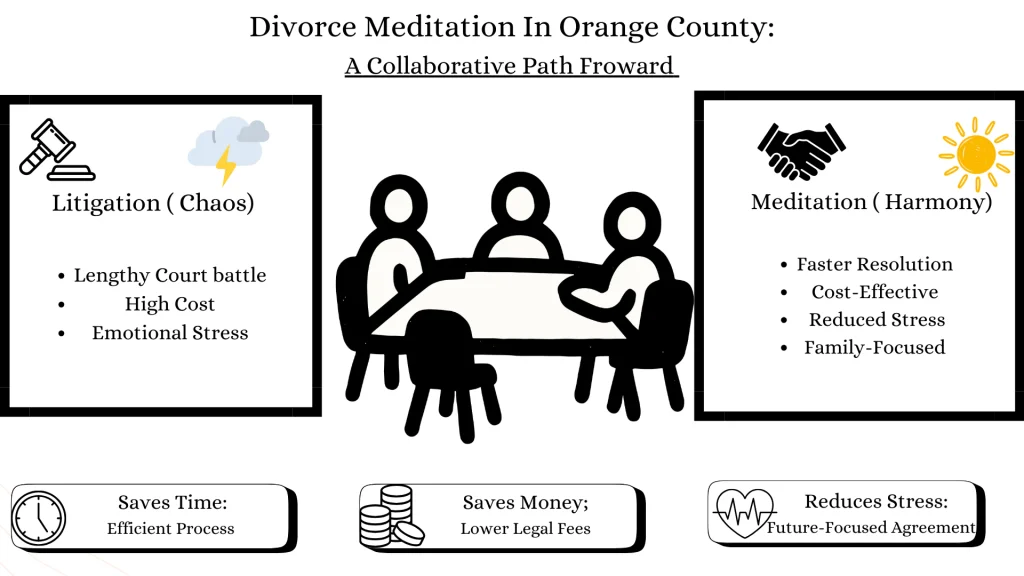
Let’s talk real numbers without the marketing spin. Private divorce mediators in California charge anywhere from $200 to $1,000 per hour, depending on their experience level, credentials, and whether they’re attorney-mediators or non-attorney professionals. A relatively straightforward mediation case with few major disputes might wrap up completely in 5 to 10 structured sessions, costing between $3,000 and $8,000 total for both spouses combined. More complex cases involving significant assets, business valuations, or contentious custody battles can run $15,000 to $25,000 or more.
Now compare that to traditional litigation with attorneys. If you each hire separate divorce lawyers and proceed through the court system, you’re realistically looking at $15,000 to $40,000 per spouse—and that’s for a relatively standard case. High-conflict divorces with extensive discovery, multiple motions, custody evaluations, and actual trial time can easily hit six figures combined. The difference isn’t just the hourly billing rate—it’s the sheer amount of time consumed.
Litigation involves formal discovery processes, written interrogatories, depositions, motions practice, mandatory court appearances, waiting months for a spot on a judge’s crowded calendar, and countless hours of attorney preparation time that you’re paying for. Mediation strategically cuts out most of that expensive procedural machinery while still producing a legally enforceable result.
Flat-fee mediation pricing is becoming increasingly common and popular in Orange County because it provides cost certainty from the very beginning. Some experienced mediators charge a set, all-inclusive price for the entire divorce process, typically ranging from $5,000 to $9,000, which includes all mediation sessions, document preparation, and filing assistance. This transparent pricing model gives you complete cost predictability from day one, which matters enormously when you’re trying to budget carefully for maintaining two separate households on what was previously one combined income.
The alternative is traditional hourly billing, where you pay the mediator’s rate for every hour spent—including session time, document review, research, and communication. Hourly rates give you flexibility to use only the services you actually need, but they can create anxiety about costs spiraling if negotiations take longer than expected. Some mediators offer a hybrid model: hourly mediation sessions plus a flat fee for all paperwork and court filing services.
When evaluating cost, also factor in what you’re not paying for in mediation. You’re avoiding separate attorney retainers (often $5,000 to $15,000 each just to start), discovery costs, court reporter fees for depositions, expert witness fees for contested hearings, and the countless billable hours attorneys spend on motions, responses, and court preparation. Even if mediation takes more sessions than initially expected, you’re still typically spending a fraction of what litigation would cost.
Many Orange County mediators also offer payment plans or sliding scale fees based on income for couples who genuinely can’t afford the standard rates upfront. It’s worth asking about options—mediation is designed to be more accessible than traditional litigation, and many professionals in the field are committed to making it financially feasible for families who need it.
If you’re attempting to handle a divorce entirely on your own without any professional help, the baseline mandatory cost is the court filing fee: $435 per person in most California counties, including Orange County. That’s just to officially open your case with the Superior Court. From there, you’ll need to properly serve your spouse with the divorce papers, which typically costs $50 to $100 if you hire a registered process server (you can’t serve the papers yourself—California law requires a neutral third party).
If you decide to use an online divorce service or document preparation company to help with the paperwork and filing process, expect to pay anywhere from $300 to $3,000 depending on the level of support and service you choose. These services can be genuinely helpful for navigating the forms, but they’re not providing legal advice and they can’t represent you if issues arise.
But the real cost of DIY divorce isn’t always immediately financial—it’s time, stress, and potential long-term consequences. Self-filing takes significant time: hours of online research, form-filling, multiple trips to the courthouse, figuring out filing procedures, and troubleshooting when things go wrong. If you make substantive mistakes in your paperwork, you’ll spend even more time and energy fixing them. If you overlook a significant asset, agree to unfair support terms because you didn’t understand California’s guideline calculations, or create an unworkable custody schedule, the long-term financial and emotional cost can be devastating.
One commonly overlooked expense that surprises people: retirement account division. If you have a 401(k), pension, or other qualified retirement plan that needs to be split between spouses, you’ll need a Qualified Domestic Relations Order (QDRO), which is a specialized legal document that must be drafted by an attorney or QDRO specialist and approved by both the court and the plan administrator. That alone typically costs $500 to $1,200 per retirement account. Add in any necessary professional appraisals for real estate, business valuations, or forensic accounting if there are complex financial issues, and the expenses add up quickly even in what seems like a “simple” divorce on the surface.
Mediation helps you anticipate all these costs upfront, budget appropriately, and avoid expensive surprises. A knowledgeable mediator will walk you through exactly what’s required for your specific situation and connect you with the right professionals when specialized help is needed, so you’re not blindsided halfway through the process when you’ve already invested time and money.
The question isn’t really whether you can do a divorce without lawyers—you can. The better question is how to do it successfully while protecting your rights and avoiding costly mistakes. Mediation offers a structured middle path where you get expert guidance without paying for full legal representation on both sides.
In mediation, the mediator helps you navigate California’s family law requirements, understand your options, and reach fair agreements. But the mediator doesn’t represent either of you individually—they’re neutral facilitators. That’s fundamentally different from having your own attorney whose job is to advocate solely for your interests.
For many Orange County couples, this arrangement works well. You save significant money, maintain more control over the process and outcomes, and avoid the adversarial courtroom environment that can permanently damage your ability to co-parent effectively. But it requires both spouses to participate honestly, disclose all relevant information, and negotiate in genuine good faith.

Article details:
Share:
Continue learning: